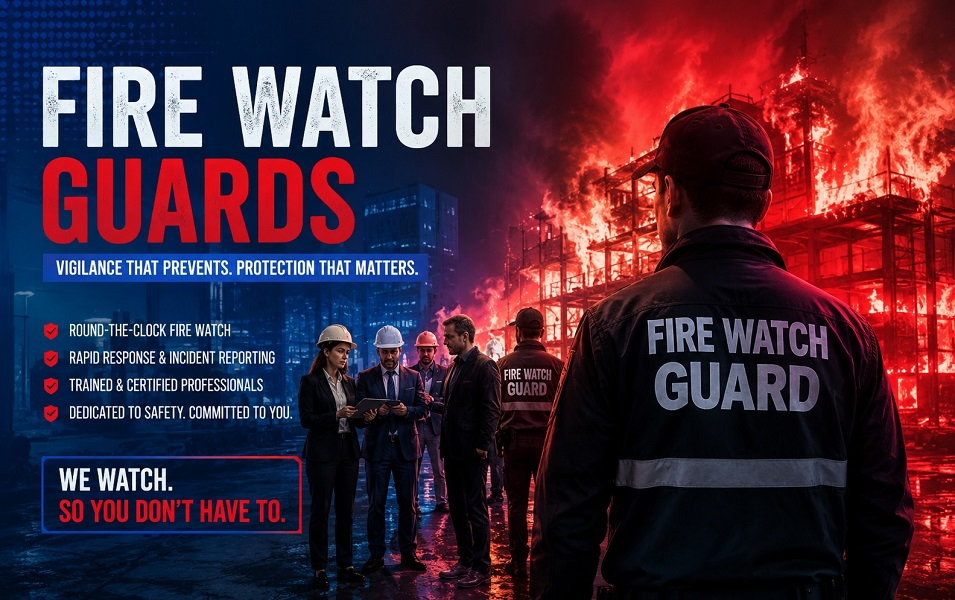
Every major fire disaster shares a chilling common thread — somewhere along the way, an early warning was missed. A smoldering wire overlooked. An unmanned zone left unchecked. A system offline with no human backup in place. Fire watch guards exist precisely to close that gap — and the evidence increasingly suggests they’re not just helpful, they’re indispensable.
The question isn’t whether trained human oversight matters in fire safety. The real question is why so many businesses still treat it as optional.
The Gap That Automated Systems Can’t Fill
Modern buildings are outfitted with sophisticated fire suppression systems, smoke detectors, and alarm networks. Yet every year, properties burn despite the technology installed inside them. The reason is deceptively simple: automated systems fail. They go offline during maintenance windows. They malfunction during power disruptions. Alarm components get damaged during construction or renovation work.
When those systems go dark, there’s a window of vulnerability that no sensor can cover. That’s the precise moment when a trained human presence becomes not just valuable — but legally and operationally essential. Fire watch guards step into this gap as the first line of defense, providing the kind of adaptive, real-time situational awareness that no algorithm can replicate.
The construction industry understands this acutely. Active construction sites host hot work, welding operations, open electrical systems, and flammable materials in close proximity — a combustible cocktail that demands eyes on the ground at all times.
What Fire Watch Guards Actually Do — And Why It’s More Than Patrol
The popular image of a security guard making lazy rounds doesn’t apply here. Fire watch professionals operate on a different level entirely. Their responsibilities span continuous surveillance, hazard identification, emergency communication, equipment verification, and incident documentation — all simultaneously.
During a single shift, a fire watch guard will conduct systematic patrols of fire-prone zones: electrical rooms, boiler areas, storage facilities holding flammable materials, and construction sites with active hot work. If faulty wiring, improperly stored chemicals, or an unattended heat source is discovered, the issue gets escalated immediately — before a spark has the chance to become a blaze.
Critically, they also verify that fire extinguishers, suppression systems, and emergency lighting are all operational. Their daily reports can be submitted directly to the fire marshal for compliance and transparency — a layer of accountability that automated systems simply don’t provide.
The Industries Where This Human Layer Is Non-Negotiable
Certain industries operate in fire-risk environments that most people never think about. Hospitals, where a sudden fire during a surgery or in an ICU wing carries catastrophic consequences. Hotels, where hundreds of sleeping guests have zero situational awareness of their surroundings at 2 a.m. Commercial high-rises, where a single floor fire can cascade into a multi-story crisis within minutes.
Construction sites are among the highest-risk environments of all. During active builds, standard fire protection systems are often not yet installed or fully operational. Hot work — welding, cutting, grinding — generates sparks that can ignite surrounding materials with terrifying speed. Fire watch professionals stationed at these sites aren’t a luxury; they’re a regulatory requirement and a moral obligation.
Industrial facilities and manufacturing plants represent another critical sector. The combination of heavy machinery, high temperatures, chemical storage, and large-scale electrical infrastructure creates a fire risk profile that demands constant human oversight. A well-trained guard who knows the facility layout can recognize anomalies that a sensor would never flag.
Training, Certification, and the Standard That Separates Professionals from Placeholders
Not every person holding a clipboard constitutes a meaningful fire watch presence. The difference between a trained fire watch professional and an untrained observer can literally be the difference between a contained incident and a catastrophic loss.
Professional fire watch personnel undergo specialized training in fire hazard recognition, firefighting equipment operation, emergency evacuation coordination, and real-time communication with fire departments, emergency medical services, and on-site management. They’re equipped with fire extinguishers and operational tools to suppress small ignition events before they escalate — buying critical minutes until professional firefighters arrive.
Reputable fire watch companies operate under state licensing requirements, carry substantial commercial liability insurance, and deploy certified guards capable of handling medical emergencies, civil unrest, and natural disaster scenarios alongside fire-specific threats. That breadth of capability reflects a broader evolution in the profession — from simple watchmen to multi-threat response professionals.
The Regulatory Reality: Compliance Isn’t Optional
Across the United States, fire codes enforced by local fire marshals mandate fire watch services any time a building’s primary fire protection system is impaired or non-functional. Failure to comply doesn’t just create physical danger — it exposes businesses to significant fines, forced shutdowns, and crushing liability exposure if a fire occurs.
This regulatory framework exists because data consistently validates its premise. Early detection and human intervention dramatically reduce both life safety risk and property damage. The National Fire Protection Association has long documented that fires identified in their earliest stages — whether by automatic systems or trained human observers — result in dramatically better outcomes than those detected after significant spread has occurred.
For businesses operating in high-risk environments, engaging certified fire watch guards isn’t a line item to be negotiated down. It’s an investment in operational continuity, employee safety, and legal compliance that pays dividends every single day without incident.
The Technology-Human Partnership Redefining Fire Safety
The future of fire safety isn’t a binary choice between technology and human presence. The sharpest operators in real estate, construction, hospitality, and industrial management already understand this — they’re building hybrid systems that layer automated detection with trained human oversight.
Fire watch guards increasingly work alongside thermal imaging cameras, IoT-connected sensors, and real-time monitoring dashboards. The technology identifies patterns; the human interprets context. A sensor might flag elevated temperature in a server room. A trained guard determines within seconds whether that reading represents a genuine escalation or routine equipment operation — and acts accordingly.
This partnership also matters at the organizational level. Fire watch guards communicate with on-site personnel, reinforce evacuation protocols, and ensure that every occupant of a facility — not just management — understands what to do when seconds matter. That culture of awareness, built through consistent human presence and professional engagement, is something no algorithm can install.
When Everything Goes Wrong, Who Do You Want in the Building?
There’s a reason that when fire protection systems fail during critical moments — during a hurricane, a grid outage, a construction accident — the first call goes out for certified Fire Watch Guards. Not more software. Not a remote monitoring center operating three time zones away. A trained, present, responsive human being who knows the building, knows the risks, and knows exactly what to do.
Companies like Just Fire Watch have built their entire operational model around this principle: that fire safety, at its most critical junctures, demands professional human commitment. The cost of deploying qualified fire watch personnel is trivial compared to what’s at stake — lives, assets, reputation, and the trust of every person who walks through a facility’s doors.
The businesses that will lead their industries in the years ahead are not those that bet everything on automation. They’re the ones wise enough to recognize where human judgment remains irreplaceable — and decisive enough to invest in it before disaster forces their hand.